022
It’s all down to the individual. – Master’s thesis by A. Catarina Nebeling
Category
Teaching
Typology
Housing
Context
University
Location
Mainz
Year
2026
024
-
Master’s thesis – Potential for terraced houses
023
-
Scenography with atelier joel joebgen
022
-
It’s all down to the individual. – Master’s thesis by A. Catarina Nebeling
021
-
Temporary installation at the church ruins with atelier joel jerome joebgen
020
-
Modular furniture design
019
-
Studio concept by atelier joel jerome joebgen
018
-
Lucy – student co-working space
017
-
Extension to the old cold store
016
-
Watching Fox
015
-
The Green House
014
-
"Ruben's Arepas" in Berlin
013
-
"Home & Office" research project
012
-
Extension to a detached house
011
-
Boniface’s Towers, Mainz
010
-
Urban living in Bad Kreuznach
009
-
Feasibility study for the Gedern nursery
008
-
Restoration of a listed building – the Old Cinema
007
-
Roof extension in Mainz-Kastel
006
-
Lounge Chair
005
-
Extension and addition of storeys to a detached house
004
-
A detached house in a small housing estate on Fliederweg
003
-
Cathedral-style
002
-
Carriage house at Bad Homburg Castle
001
-
Conversion of an existing house into a surgery
024
-
Master’s thesis – Potential for terraced houses
023
-
Scenography with atelier joel joebgen
022
-
It’s all down to the individual. – Master’s thesis by A. Catarina Nebeling
021
-
Temporary installation at the church ruins with atelier joel jerome joebgen
020
-
Modular furniture design
019
-
Studio concept by atelier joel jerome joebgen
018
-
Lucy – student co-working space
017
-
Extension to the old cold store
016
-
Watching Fox
015
-
The Green House
014
-
"Ruben's Arepas" in Berlin
013
-
"Home & Office" research project
012
-
Extension to a detached house
011
-
Boniface’s Towers, Mainz
010
-
Urban living in Bad Kreuznach
009
-
Feasibility study for the Gedern nursery
008
-
Restoration of a listed building – the Old Cinema
007
-
Roof extension in Mainz-Kastel
006
-
Lounge Chair
005
-
Extension and addition of storeys to a detached house
004
-
A detached house in a small housing estate on Fliederweg
003
-
Cathedral-style
002
-
Carriage house at Bad Homburg Castle
001
-
Conversion of an existing house into a surgery
It’s all down to the individual. – Master’s thesis by A. Catarina Nebeling
Teaching
Housing
University
Mainz
2026
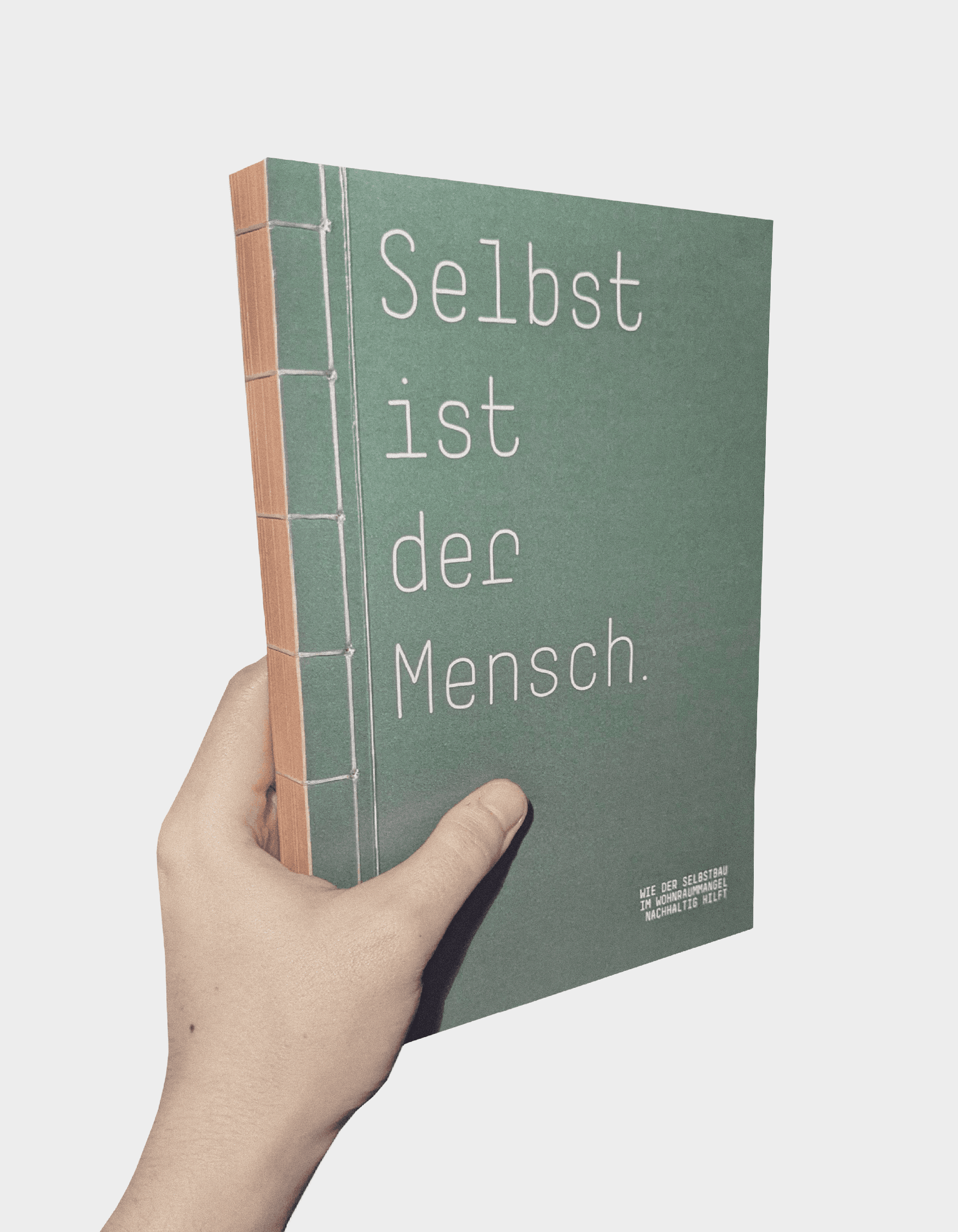
Taking the current housing shortage as its starting point, A. Catarina Nebeling’s thesis examines self-build as a potential strategy for affordable, sustainable and self-determined housing. The thesis demonstrates that self-build can be understood not merely as a form of DIY, but as a socially relevant model of participation. Residents do not merely become occupants of their homes once construction is complete; rather, they are actively involved in the construction process from the outset. They help to shape the design, make decisions and develop a direct relationship with their future living spaces.
It is
precisely in this early involvement that the particular potential of self-build lies: the collaborative creation of one’s own living environment can foster social bonds even whilst the building process is underway. A sense of community does not emerge only when residents move in, but through working together, negotiating and taking ownership. Self-build thus becomes an architectural and social tool that links housing, responsibility and community.
SELF-BUILD IS UNDERSTOOD NOT AS A MATTER OF DOING THE WORK YOURSELF, BUT AS A MODEL OF PARTICIPATION.
Anna Catarina Nebeling
People are their own masters. How DIY helps tackle the housing shortage in a sustainable way
Master’s in Architecture | Mainz University of Applied Sciences
Winter semester 2025/26
Prof. Dr Julius Niederwöhrmeier
M.Sc. Daniel Ercin
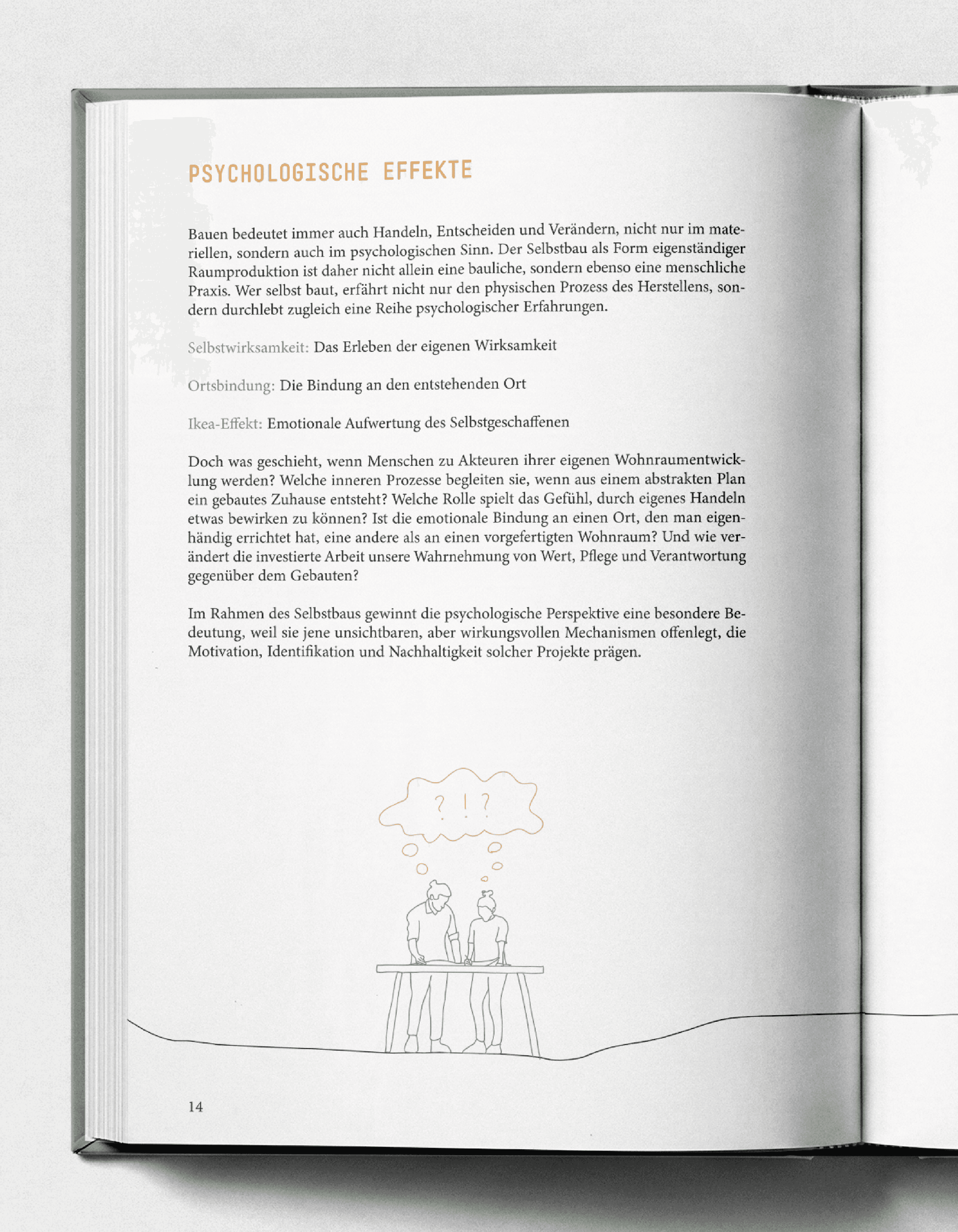
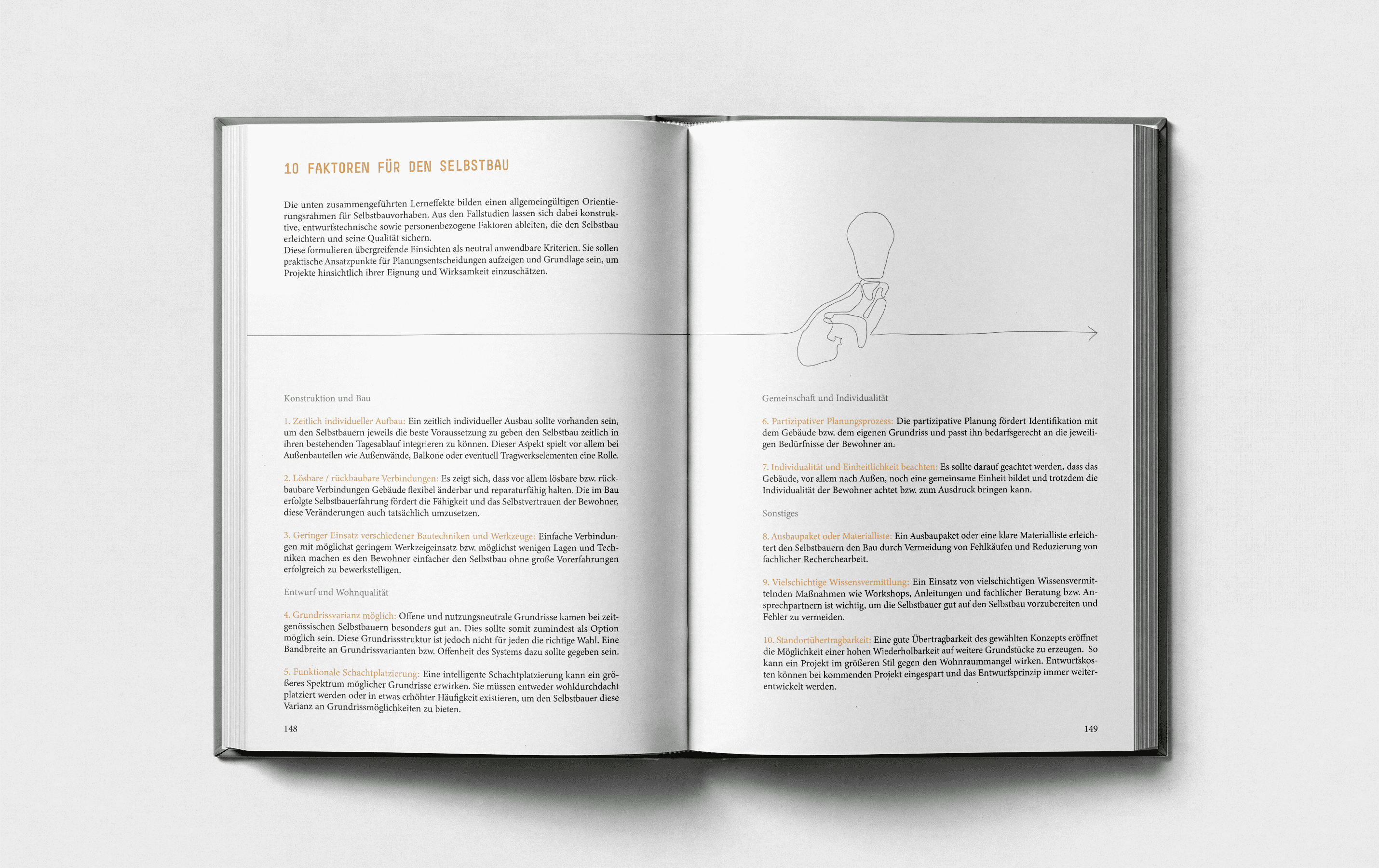
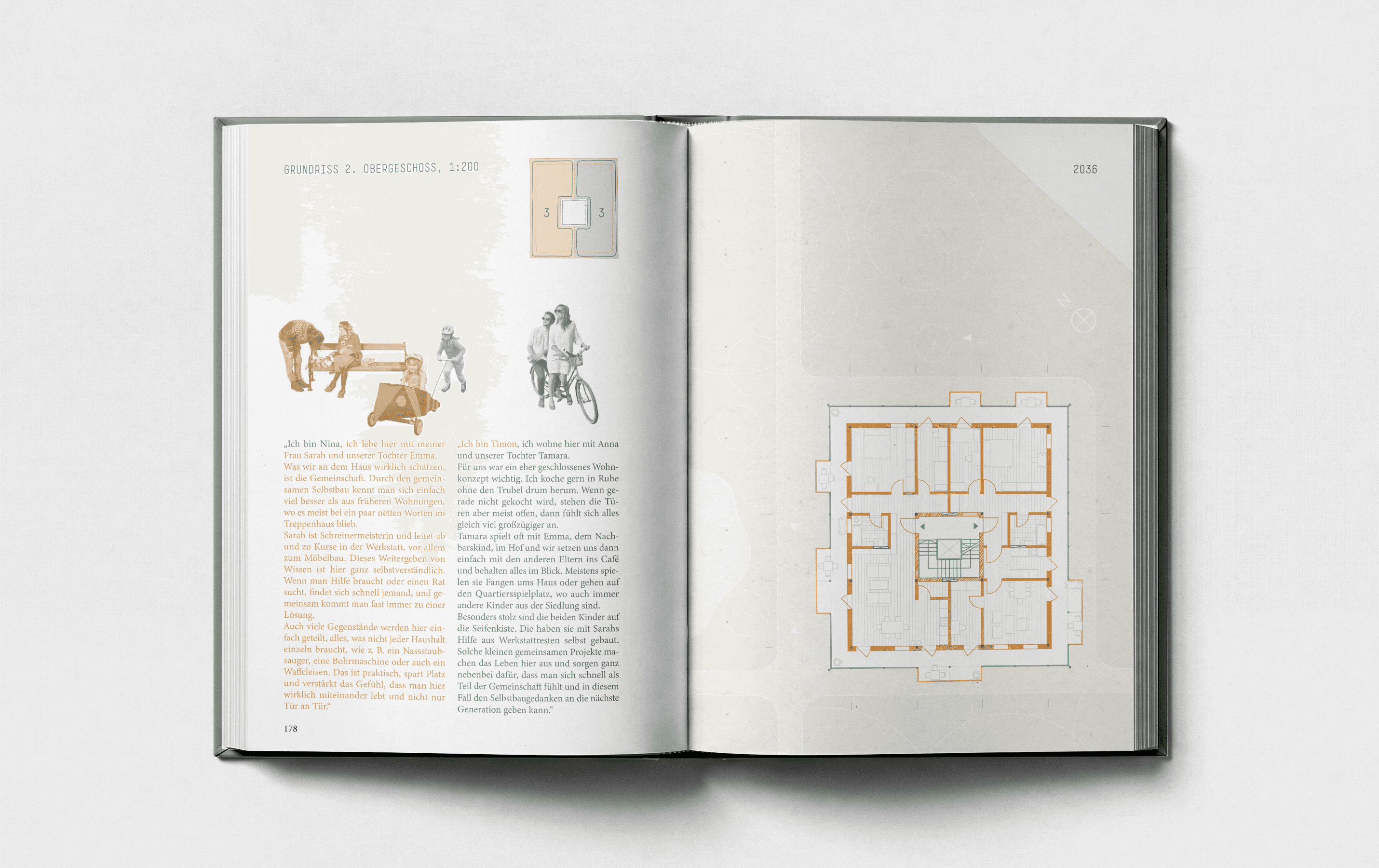
Through historical and theoretical research, this work examines self-build from various perspectives. It examines built examples, social effects, construction conditions and planning factors. Historical settler movements, communal housing models and contemporary self-build projects are analysed to determine their applicability to contemporary forms of housing.
→ An important point of reference is the Walter Segal Estate, where simple construction, self-build and communal organisation are combined to form an exemplary housing model. In addition, the thesis considers psychological aspects such as the ‘Ikea effect’: personal involvement in the construction process can strengthen one’s identification with the result.
RESEARCH – REFERENCES – MATERIALS – TRADES – CRITERIA – APPLICABILITY
→‹The work is particularly thorough in its research into materials and trades. An evaluation matrix is used to examine which components and work stages can be carried out safely, comprehensibly and cost-effectively by the residents themselves, even without prior specialist knowledge. This results in a catalogue of criteria that does not romanticise DIY, but rather assesses it as a plannable architectural process.
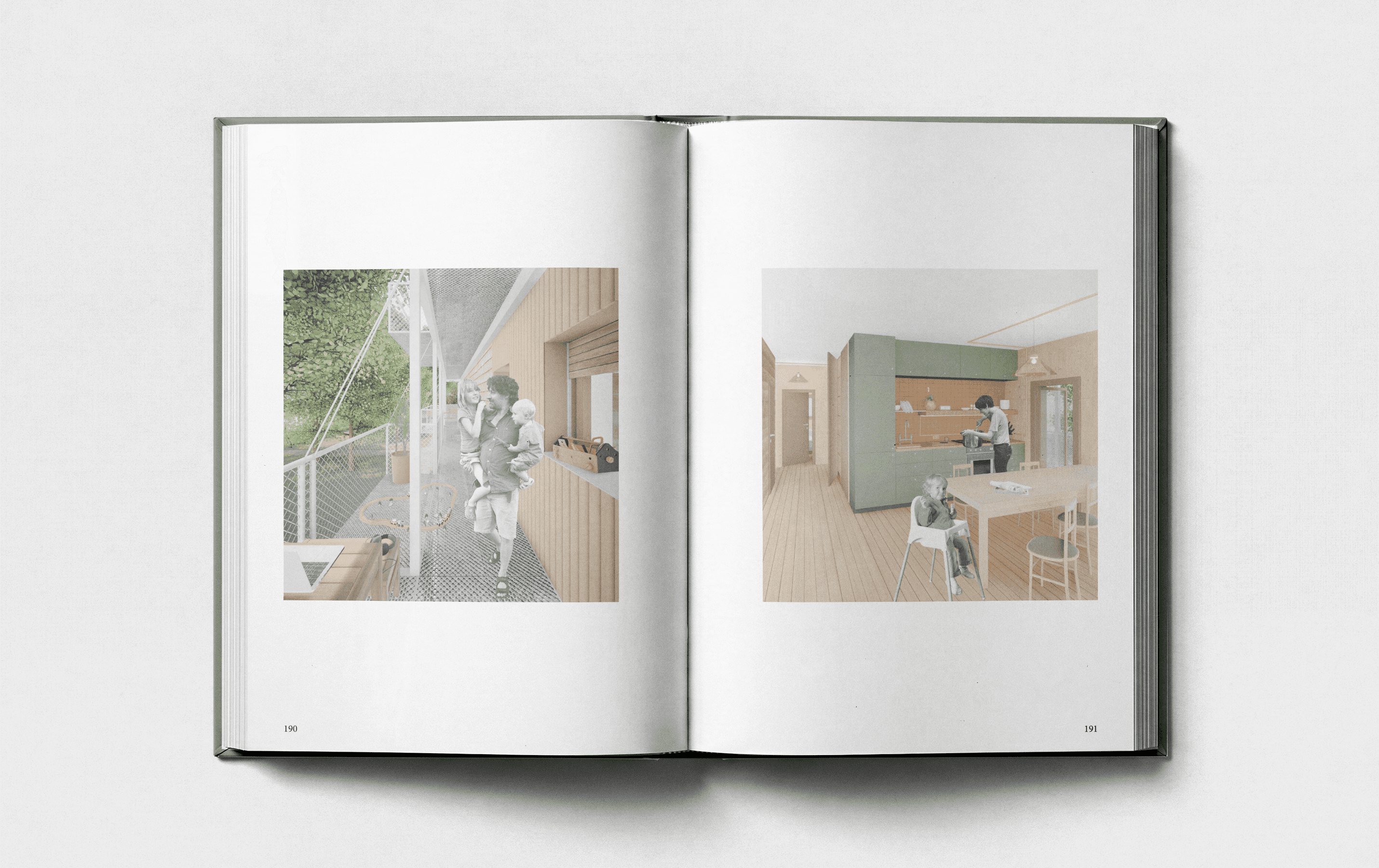
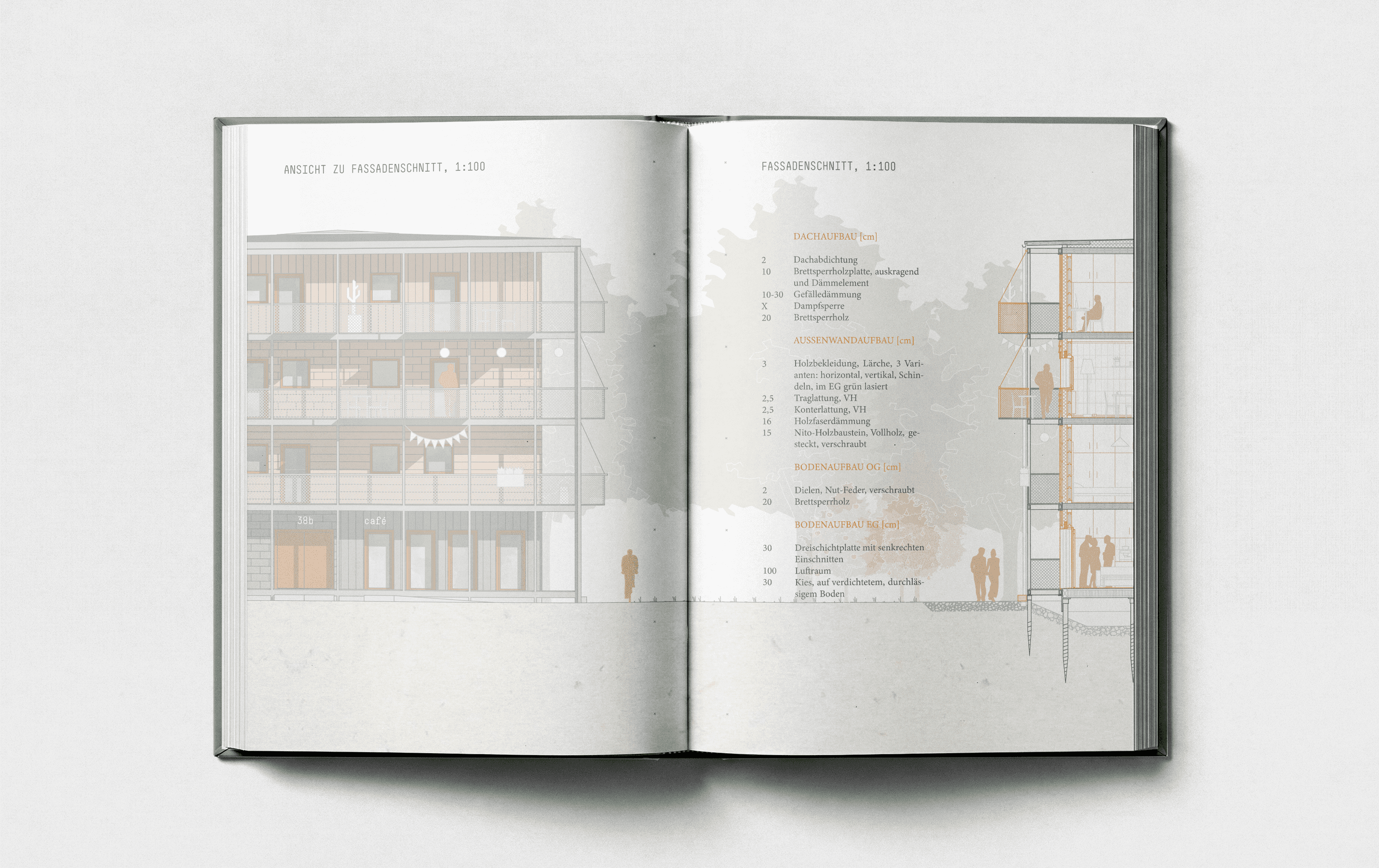
The transition from researched knowledge to architectural realisation is particularly compelling. With the selection of a specific plot of land, the principles developed previously are translated into a case study of their own. Design thinking serves as a methodological tool to integrate users, processes, construction and appropriation into a coherent whole.
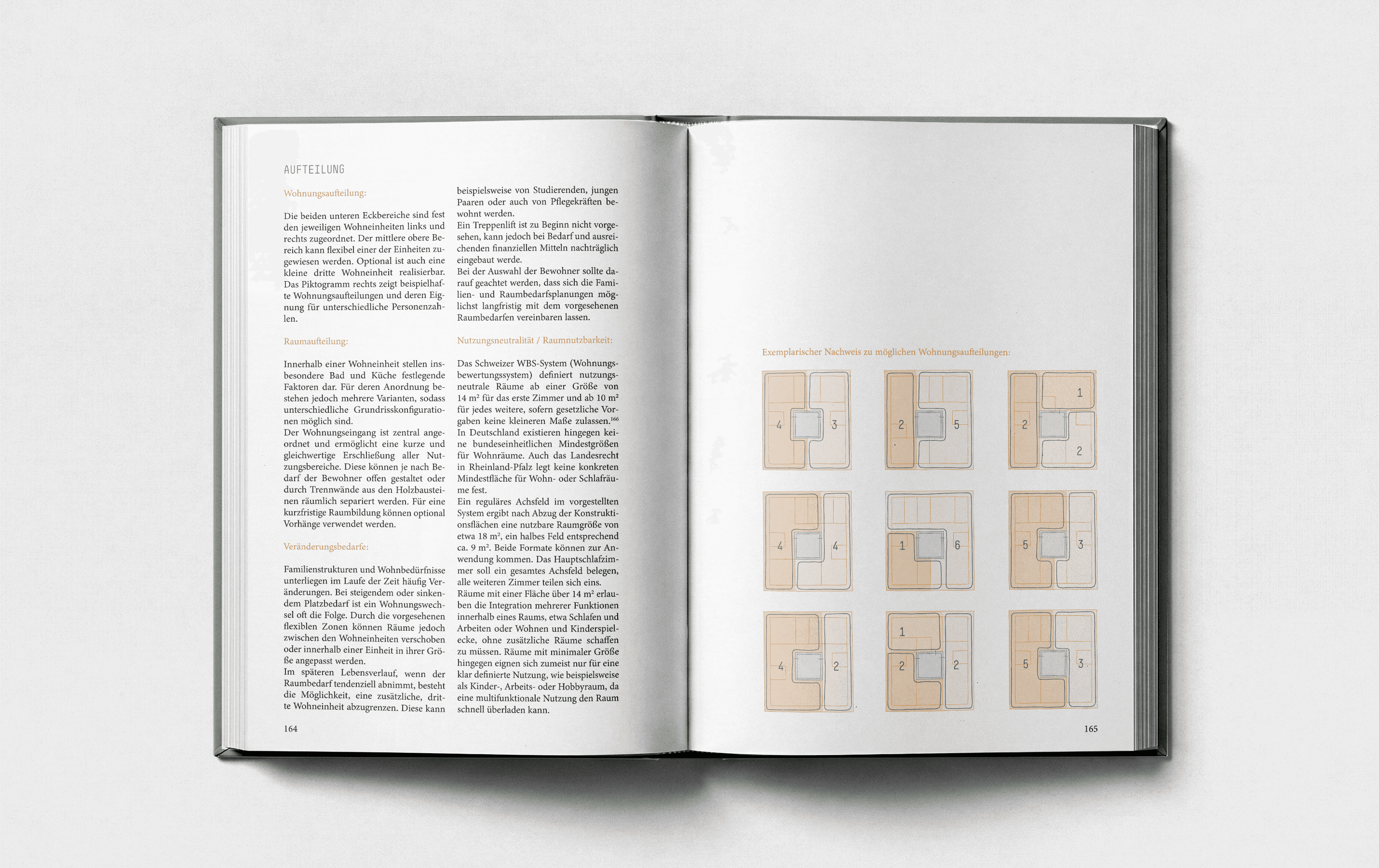
The design proposes a multi-family dwelling as a hybrid timber-and-clay structure. At its heart lies a solid stairwell core made of rammed earth, which serves both as a structural element and a communal focal point. The future residents are to build this core together – thus, the stairwell becomes a collective space even during the construction process. The rest of the structure also follows the principle of a straightforward and accessible construction method. Timber framing and Nito blocks are combined using simple, straightforward joints, opening up opportunities for residents to contribute their own labour.
→ In this way, self-build is not seen as an add-on, but as an integral part of the construction, the process and communal ownership.
THE DESIGN TRANSLATES THE RESEARCH INTO A CONSTRUCTION METHOD THAT NOT ONLY PERMITS PARTICIPATION BUT ALSO ACTIVELY INCORPORATES IT.